

Decentralized
Decentralized Clinical Trial Logistics
Strategic Lab Partners supports decentralized clinical trial logistics for sponsors, CROs, diagnostics companies, and research organizations that need controlled kitting, reliable specimen workflows, documented handoffs, and audit-ready visibility across distributed operations.
Decentralized and hybrid trials create operational complexity across patients, sites, couriers, labs, depots, inventory locations, returns, and exception queues. SLP helps translate protocol requirements into controlled kit design, fulfillment workflows, shipment visibility, returnmanagement, and chain-of-custody documentation.
Through SLP CONNECT™, trial operations teams can gain a structured view of kit status, inventory movement, shipment activity, exceptions, returns, and documentation history. The result is a more visible and controlled operating model for clinical trial programs where sample integrity, timing, and evidence matter.
The question for enterprise decision makers is no longer simply:
Can We Run a Decentralized Trial?
The Better Question Is: Can we see, control, document, and reconcile every kit, sample, handoff, exception, and return well enough to support operational performance and audit readiness?
For Many Organizations, ThIs Is Where Decentralized Trial Logistics Becomes the REAL Bottleneck.
Emerging best practice: “Audit-ready operational evidence
layers” for decentralized healthcare and clinical trial logistics.
Decentralized clinical trials are no longer experimental. FDA’s final guidance on Conducting Clinical Trials With Decentralized Elements confirms that decentralized elements are now part of the modern clinical trial operating model, including trial activities occurring outside traditional clinical sites.
The FDA also emphasizes that sponsors and investigators must account for coordination, records, local healthcare providers, remote data capture, investigational products, safety monitoring, and appropriate oversight in decentralized models. That creates a clear need for operational infrastructure—not just patient-facing technology.
Industry analysis also points to the same issue: decentralized trials, personalized medicine, biologics, complex protocols, real-time tracking, temperature-sensitive logistics, direct-to-patient models, and regulatory traceability are increasing clinical trial supply chain complexity.
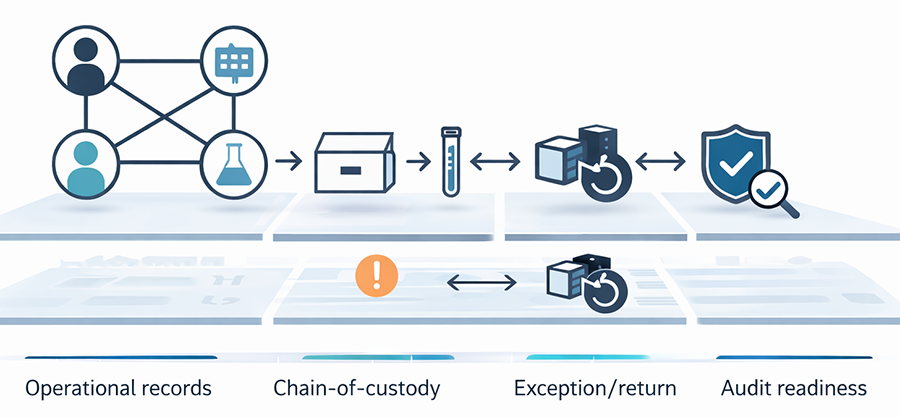
The Next Competitive Advantage in decentralized clinical trials will not come only from recruitment apps, telehealth, or wearable devices. It will come from operational visibility, chain-of-custody control, exception management, and audit-ready logistics infrastructure.
YES. DCTs ARE SCALING,
BUT OPERATIONAL COMPLEXITY IS SCALING FASTER
Decentralized and hybrid trials can include home collection, local lab participation, remote visits, telehealth, mobile care teams, direct-to-patient shipments, courier handoffs, remote monitoring, and distributed sample returns. Each decentralized element adds flexibility, but it also adds more operational touchpoints.
FDA guidance highlights many of these realities, including decentralized activities, local healthcare providers, remote data capture, investigational product handling, safety monitoring, records, and oversight responsibilities.
This means decentralized trials require more than fulfillment. They require a controlled operating model, AND a single trial may involve:
- Protocol-specific kit configuration
- Patient or site shipment
- Sample collection
- Courier pickup
- Local healthcare provider involvement
- Lab receipt
- Accessioning or processing
- Temperature or timing requirements
- Exception management
- Return logistics
- Documentation review
- Reconciliation
- Sponsor reporting
In a traditional centralized model, many of these activities occur within a more controlled site environment.
In a decentralized model, the workflow spreads across people, locations, systems, and vendors. Without operational infrastructure, visibility gaps can emerge quickly.
The Hidden Risk: Every Handoff Becomes a Potential Evidence Gap
In decentralized clinical trial logistics, the handoff is where risk concentrates. A kit leaves inventory. A shipment goes out. A participant receives materials. A sample is collected. A courier picks it up. A lab receives it. An exception occurs. A replacement kit is sent. A return is initiated. A billing event is triggered. A reconciliation question appears.
Each of those events may be handled by a different party or system. If the operational record is fragmented across spreadsheets, emails, carrier portals, screenshots, and manual updates, the trial team may not have a single reliable view of what happened AND this creates practical problems:
Delayed exception identification
Increased customer or site status inquiries
Manual reconciliation burden
Preventable reships or redraws
Unclear sample or kit status
Disconnected billing and return records
Difficult audit preparation
Poor visibility into recurring failure patterns
For enterprise teams, the issue is not only whether a shipment arrived. The issue is whether the organization can prove what happened across the workflow and act before small exceptions become larger operational problems.
Why General 3PL Is Not Enough for Decentralized Clinical Trials
Broad 3PL providers can be strong at scale, warehousing, and general fulfillment. But decentralized clinical trial logistics requires a more specialized model.
A regulated DCT logistics partner must understand that a clinical trial kit is not just a package. A specimen is not just freight. A return is not just reverse logistics. A handoff is not just a shipping status.
Each event may affect sample integrity, participant experience, protocol execution, downstream lab performance, sponsor confidence, billing accuracy, and audit readiness.
That is why the enterprise buying question should not be: Who can ship this?
It should be: Who can control, document, and reconcile this decentralized clinical workflow from protocol-to-kit through final return?
This is where Strategic Lab Partners has a defensible role.

Decentralized Clinical Trial Logistics FAQs
Q: What is decentralized clinical trial logistics?
Decentralized clinical trial logistics refers to the kitting, fulfillment, shipment, sample return, inventory, courier, site, patient, and documentation workflows required to support clinical trial activity outside a fully centralized site model.
Q: How does SLP support decentralized and hybrid trials?
SLP supports decentralized and hybrid trials through protocol-specific kitting, controlled fulfillment, specimen collection workflows, shipment and return visibility, exception management, and SLP CONNECT™ chain-of-custody reporting.
Q: Why does chain-of-custody matter in decentralized trials?
Chain-of-custody helps trial teams understand where a kit or sample is, who handled it, what occurred, when status changed, and which exceptions require action. This visibility supports better operational control and audit readiness.